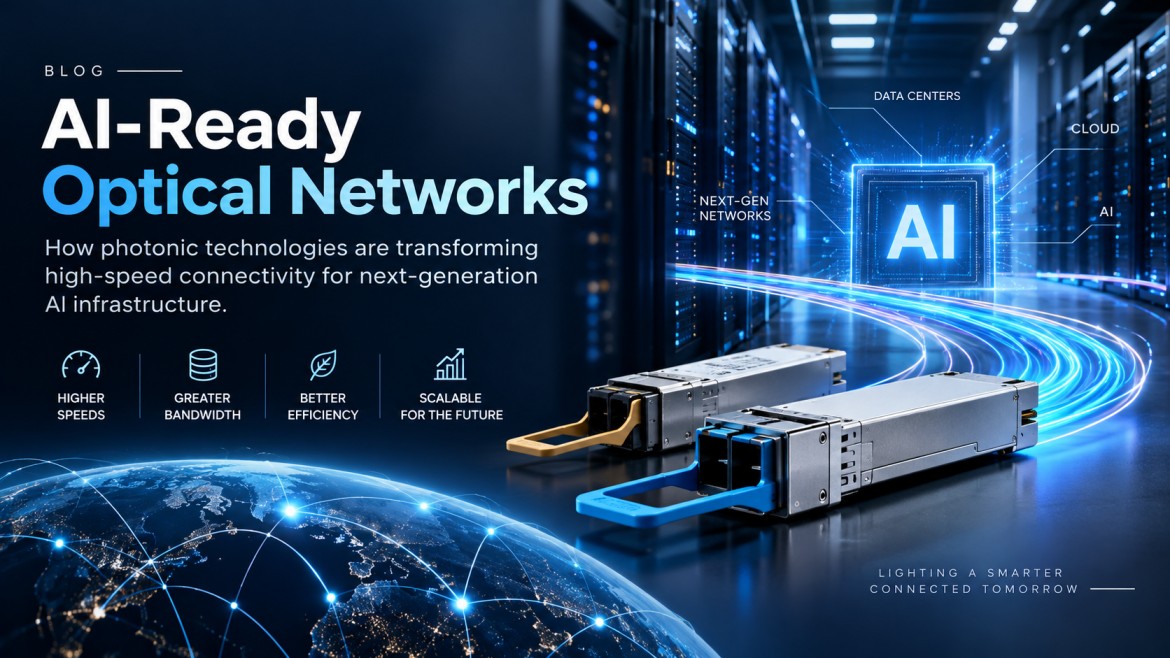
Explore how photonic technologies, optical networks, PICs, and high-speed transceivers are enabling faster, more efficient, and scalable connectivity for next-generation AI infrastructure.
In this article
- •The Rise of AI-Driven Networks
- •Why Traditional Networks Are Under Pressure
- •Understanding Photonic Technology
- •The Role of PICs in Optical Communication
- •SFP and QSFP: Enabling High-Speed Connectivity
- •Improving Network Efficiency
- •Improving Network Efficiency
- •Building Future-Ready Networks
- •The Future of AI and Photonics
- •Conclusion
Artificial intelligence is transforming digital infrastructure at an unprecedented pace. From generative AI and machine learning to high-performance computing and cloud applications, modern workloads require enormous amounts of data to move quickly and reliably.
As computing power increases, the network connecting these systems must evolve as well. High bandwidth, low latency, scalability, and energy efficiency are becoming essential requirements for modern AI infrastructure.
This is where optical networking and photonic technologies play a critical role.
1. The Rise of AI-Driven Networks
AI applications are generating larger datasets and requiring increasingly powerful computing environments. AI models, GPUs, servers, and storage systems must continuously exchange massive amounts of information.
This creates significant demands on the network infrastructure connecting these resources.
Modern AI networks need to deliver:
- High-speed data transmission
- Low-latency communication
- Reliable connectivity
- High bandwidth
- Scalable architecture
- Efficient power consumption
As AI workloads continue to expand, networking is becoming a fundamental part of overall computing performance.
2. Why AI Needs High-Speed Connectivity
AI systems often operate across large clusters of processors and servers. These systems constantly exchange data during training, inference, and other computational processes.
A network bottleneck can limit the performance of even the most powerful computing hardware.
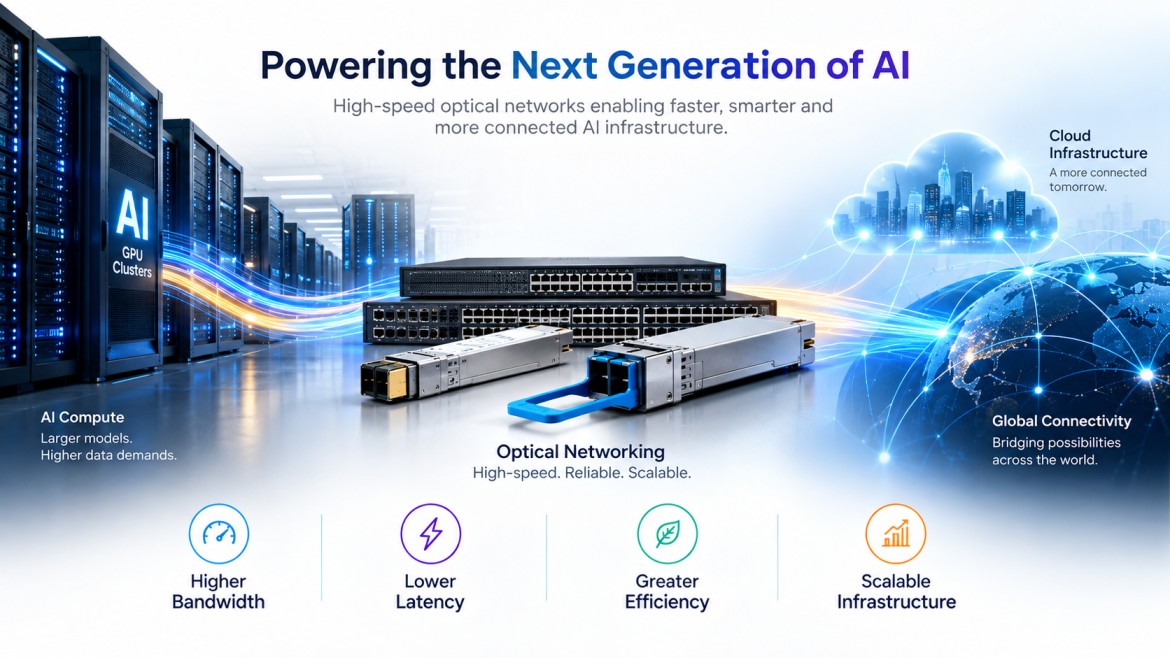
High-speed optical connectivity helps move large volumes of data between:
Servers → Switches → Storage → GPU Clusters → Data Centers
This makes fast and reliable connectivity essential for keeping AI workloads running efficiently.
3. Understanding Photonic Technology
Photonic technology uses light to transmit and process information.
Optical communication can provide high-speed data transmission while supporting the growing bandwidth requirements of modern infrastructure.
Compared with traditional electrical interconnects, optical technologies are particularly valuable for applications requiring:
- High bandwidth
- Long-distance transmission
- Low latency
- High-density connectivity
- Scalable infrastructure
As data requirements continue to grow, photonics is becoming an important technology for next-generation networking.
4. Photonic Integrated Circuits (PICs)
Photonic Integrated Circuits (PICs) bring multiple optical functions together on a compact chip.
Depending on the application, PICs can integrate components such as optical waveguides, modulators, lasers, and photodetectors.
This integration can help create optical systems that are:
- Compact
- High performance
- Scalable
- Energy efficient
- Suitable for high-density applications
PIC technology is helping move optical communication toward more integrated and scalable solutions for future networks.
5. The Role of SFP and QSFP Transceivers
Optical transceivers such as SFP and QSFP provide a critical connection between networking equipment and optical fiber.
They are commonly used in:
- Network switches
- Routers
- Servers
- Data centers
- High-speed communication systems
As network speeds increase, advanced transceiver technologies help support higher data rates while maintaining reliable optical connectivity.
These solutions form an important part of the infrastructure required to connect modern computing and networking environments.
6. Optical Networks for AI Infrastructure
AI infrastructure requires connectivity that can scale alongside computing capacity.
Optical networking can support high-speed communication between distributed computing resources, helping organizations build infrastructure capable of handling increasingly demanding workloads.
An AI-ready optical network should focus on four key areas:
High Bandwidth
Support the movement of large datasets and AI workloads.
Low Latency
Enable fast communication between computing resources.
Scalability
Allow the network to grow as AI infrastructure expands.
Reliability
Maintain consistent connectivity across critical systems.
7. Improving Network Efficiency
Performance is only one part of modern infrastructure. Energy efficiency is also becoming increasingly important.
As data centers deploy larger numbers of servers, GPUs, and networking devices, optimizing how data moves through the infrastructure becomes critical.
Photonic technologies can contribute to more efficient high-speed communication by supporting high bandwidth and scalable optical connectivity.
The goal is simple:
More Bandwidth. Lower Latency. Greater Efficiency.
8. Building Future-Ready Networks
Organizations preparing for AI adoption need infrastructure that can support both today's requirements and tomorrow's growth.
A future-ready network should combine:
High-Speed Connectivity
Advanced optical solutions for demanding data-transfer requirements.
Scalable Infrastructure
Networking that can expand as computing workloads increase.
Intelligent Management
Better visibility, monitoring, and control of network resources.
Reliable Performance
Stable connectivity for critical applications and services.
By combining these capabilities, organizations can create a stronger foundation for next-generation digital infrastructure.
9. The Future of AI and Photonics
The convergence of AI, photonics, and high-speed networking is creating new possibilities for digital infrastructure.
As AI models become more sophisticated and computing clusters grow larger, the ability to move data efficiently will become increasingly important.
Future developments in photonics are expected to focus on:
- Higher data rates
- Lower latency
- Greater integration
- Improved energy efficiency
- Higher-density optical systems
- Scalable AI connectivity
Photonic chips, optical engines, and advanced transceivers will continue to play an important role in this evolution.
10. Conclusion
The future of AI depends not only on powerful processors but also on the networks that connect them.
As data volumes continue to increase, optical networking and photonic technologies provide an important pathway toward faster, more scalable, and efficient connectivity.
From PICs and optical engines to SFP/QSFP transceivers and high-speed network infrastructure, these technologies are helping build the foundation for the next generation of AI-powered systems.
**Powerful AI needs powerful connectivity.